

Best Free Online Puzzle Games You Need to Try Right Now
Why Free Online Puzzle Games Are Worth Your Time
Free online puzzle games deliver genuine entertainment without asking for anything in return — no credit card, no download, no account required. You open a browser tab and you're playing within seconds.
That frictionless access is part of the appeal, but it's not the whole story. Puzzle games work because they tap into something deeply satisfying: the moment a solution clicks into place. Whether you're untangling a logic sequence or clearing a board of matched tiles, that small rush of completion keeps people coming back.
The variety available today is remarkable. You can spend five minutes on a quick crossword during a coffee break, or sink two hours into a complex escape room scenario on a rainy afternoon. Browser-based games have matured to the point where they rival the quality of paid mobile apps — and many run perfectly on both desktop and phone without any adjustments needed.
For casual gamers especially, free puzzle games hit a sweet spot: low commitment, immediate reward, and enough depth to stay interesting over time.
Classic Puzzle Games That Never Get Old
Timeless formats like Sudoku, crosswords, and jigsaw puzzles remain among the most-played free online games for a simple reason — they work. The rules are familiar, the challenge scales naturally, and there's always a new puzzle waiting.
Sudoku is the undisputed champion of number-based logic puzzles. A 9×9 grid, nine digits, and the rule that each row, column, and box must contain every number exactly once. Simple to describe, endlessly varied in execution. Most online versions offer difficulty tiers from beginner to expert, so the same format serves a first-timer and a seasoned solver equally well.
Crossword puzzles bring a different kind of satisfaction — vocabulary, trivia, and lateral thinking all at once. Many free platforms refresh their crossword library daily, which means there's always a reason to return. Mini crosswords (5×5 grids) are worth trying if the full-size version feels daunting at first.
Online jigsaw puzzles deserve more credit than they typically get. Modern browser-based versions let you choose piece count (anywhere from 12 to 1,000+), rotate pieces, and even collaborate with others in real time. The meditative quality of sorting and placing pieces is hard to replicate in other game formats.
These classics share one key trait: no learning curve for the rules. You can pick up where you left off after a week away without needing to relearn anything.
Logic and Brain-Teaser Games for a Real Mental Challenge
Logic puzzles and brain-teasers go further than pattern recognition — they demand structured thinking, and the best ones will genuinely stump you before the solution becomes obvious in hindsight.
A few formats stand out for their depth:
- Nonograms (Picross) — Grid-based puzzles where number clues reveal a hidden pixel image. The satisfaction of watching a picture emerge from pure logic is unlike anything else in casual gaming.
- Kakuro — Often described as a crossword-Sudoku hybrid, Kakuro requires filling intersecting rows and columns with digits that sum to specific targets. Harder than it looks.
- River crossing and sliding block puzzles — Classic problem-solving formats that strip away all decoration and leave only the constraint. Some of these puzzles have solutions that require 80+ moves, which makes the eventual breakthrough feel earned.
- Tower of Hanoi variations — The original requires moving a stack of discs between pegs following strict rules. Modern browser versions add visual polish and extra layers of complexity.
What separates logic puzzle games from other casual formats is the demand for patience. You can't brute-force most of these — you have to think. That's exactly what makes them rewarding for players who find match-3 games too passive after a while.
A useful approach: start with the easiest difficulty setting even if you consider yourself experienced. Logic puzzles often have mechanics that aren't intuitive until you've seen them a few times. Getting one clean win at an easy level teaches you more than struggling blindly at medium.
Match-3 and Tile Games: Easy to Learn, Hard to Put Down
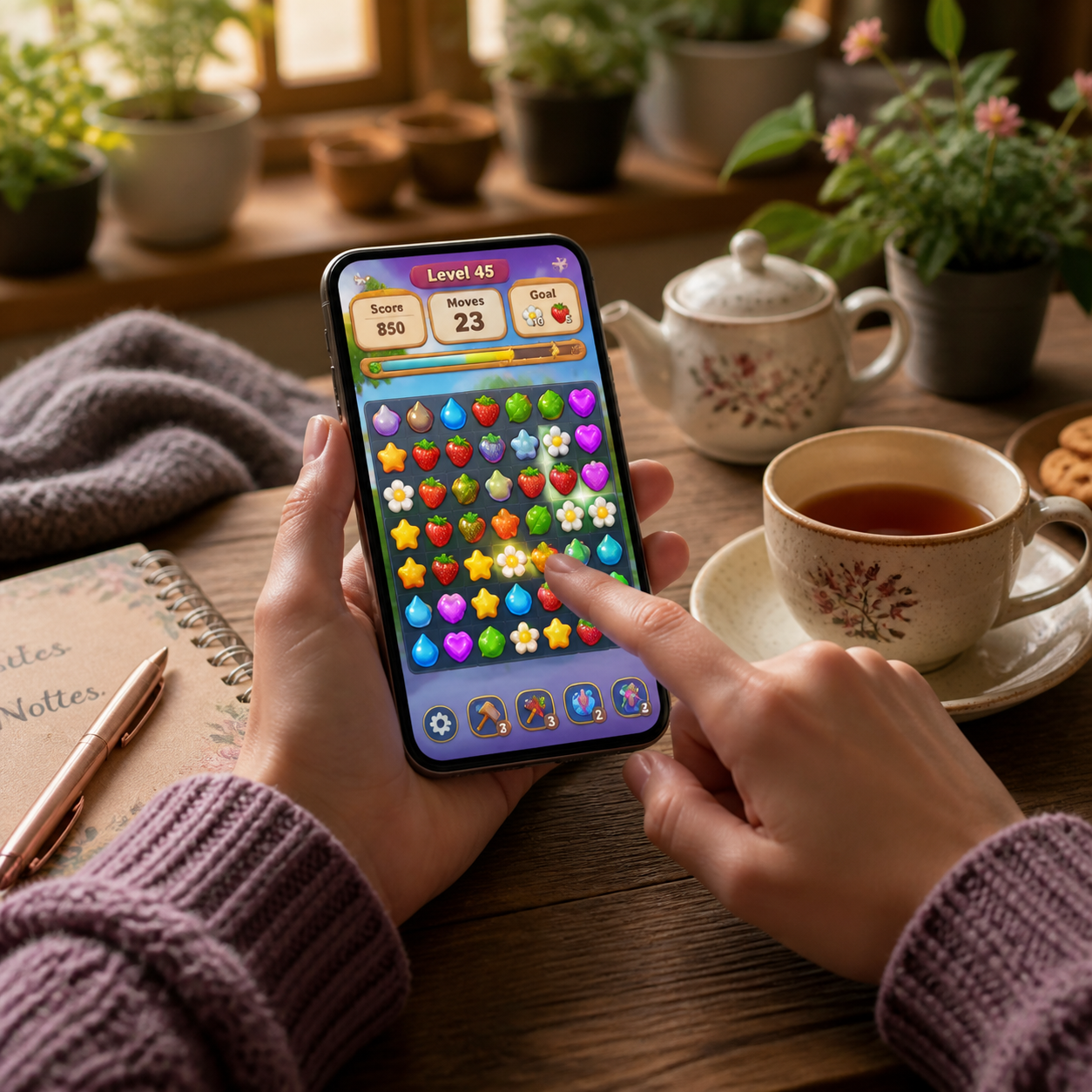
Match-3 games are the most accessible entry point in the puzzle genre — align three or more identical tiles to clear them, earn points, and work toward a level goal. The format is immediately understandable, which is why it's remained dominant in casual gaming for over two decades.
What keeps these games compelling long after the basics are mastered is the layered complexity that good designers build in. Special tiles that clear entire rows, cascading combos that trigger chain reactions, time pressure, move limits — the simple core mechanic supports enormous variety in how levels are structured.
Mahjong solitaire is a tile-matching cousin worth highlighting separately. Instead of swapping adjacent pieces, you remove pairs of matching tiles from a stacked layout. The challenge comes from planning ahead — some tiles are only accessible once others are cleared, so every move has consequences several steps out.
These games tend to be the most mobile-friendly of all puzzle formats. Touch controls map naturally to swapping and tapping tiles, and most sessions can be completed in under five minutes — ideal for commutes or short breaks.
One honest trade-off: match-3 games can feel repetitive after extended sessions. The fix is simple — play in shorter bursts, or alternate with a logic puzzle that demands a different kind of attention.
Escape Room and Mystery Puzzle Games Online
Online escape room games bring narrative and atmosphere to puzzle-solving in a way that no other format quite matches. The premise is consistent: you're trapped in a location, and the only way out is to find clues, solve interconnected puzzles, and piece together what happened.
The best browser-based escape rooms combine environmental storytelling with genuine puzzle design. A locked box might require a code found by decoding a painting on the wall, which itself requires a clue hidden in a book you found earlier. That chain of discovery — and the moment it all connects — is what makes the format so compelling.
Mystery puzzle games expand on this by adding longer narratives and character-driven stories. Some span multiple chapters, each ending on a cliffhanger that pulls you into the next session. Unlike standalone puzzles, these games reward players who pay attention to details and take notes.
A few things to know before diving in:
- These games tend to run longer than other puzzle formats — budget 30 to 90 minutes for a full escape room experience.
- Most are point-and-click in format, which works well on desktop but can feel awkward on smaller phone screens.
- If you get stuck, a quick search for a walkthrough is completely normal. The genre has a long tradition of players helping each other through particularly cryptic sections.
For players new to the format, starting with a shorter, lighter escape room (typically labeled "easy" or designed for beginners) gives you a feel for the mechanics before committing to a longer mystery.
Tips for Getting the Most Out of Free Online Puzzle Games
A few habits separate players who enjoy puzzle games consistently from those who burn out or lose interest quickly.
Bookmark your favorites before you need them. It sounds obvious, but most people rediscover a great game by accident, play it once, and then can't find it again a week later. Build a small folder of go-to games so you're never starting from scratch when you have fifteen minutes to fill.
Rotate between genres rather than playing the same format every day. Alternating between a logic puzzle and a casual match-3 game keeps both feeling fresh. The mental shift between different types of problem-solving also prevents the fatigue that comes from doing the same cognitive task repeatedly.
Set a loose time limit when you sit down to play, especially with escape room games that can expand to fill however much time you give them. Twenty or thirty minutes is usually enough to make meaningful progress without losing an entire evening.
Don't skip the tutorial even if you think you know the format. Many browser-based puzzle games have mechanics that look familiar but work slightly differently from what you've played before. Two minutes with the tutorial saves ten minutes of confusion later.
Finally, if a puzzle genuinely isn't clicking after several attempts, move on. Free online puzzle games exist in abundance — there's no reason to spend your leisure time frustrated with a single level when dozens of other great puzzles are a click away.
How to Find More Quality Free Puzzle Games
The best way to consistently find quality free puzzle games is to use curated sources rather than searching broadly. General search results for "free online games" surface a lot of ad-heavy, low-quality sites alongside genuinely good ones — the signal-to-noise ratio is poor.
Casual gaming portals that specialize in browser-based games do the filtering work for you. They test games, organize them by genre and difficulty, and update their libraries regularly. Bookmarking a reliable portal means your next great puzzle game is always one click away rather than buried in search results.
Community recommendations are another strong signal. Puzzle gaming communities on forums and social platforms regularly surface hidden gems — games that don't have marketing budgets but are genuinely excellent. A recommendation from someone who plays the same genre you enjoy is worth more than any algorithm-driven suggestion.
When evaluating a new game or site, look for these indicators of quality:
- No mandatory account creation to play
- Works without Flash or special plugins (modern browser games use HTML5)
- Clear difficulty labels so you can match the game to your current mood
- Mobile-responsive design if you play on a phone or tablet
The puzzle video game genre has a rich history stretching back decades, and the free browser-based corner of that world is more active than ever. New games appear regularly, classic formats get thoughtful updates, and the barrier to entry remains zero. There's genuinely never been a better time to explore what's available.
Frequently Asked Questions
Are free online puzzle games safe to play without signing up?
Yes — the vast majority of quality free puzzle games require no account or personal information. You navigate to the game and start playing immediately. Reputable casual gaming portals host these games without requiring registration, and you can play anonymously without any risk to your privacy.
Can I play these puzzle games on my phone or tablet?
Most modern free puzzle games are built with HTML5, which means they run in any browser on any device — phone, tablet, or desktop. Match-3 and jigsaw games tend to work especially well on touchscreens. Escape room games are generally better on desktop due to their point-and-click mechanics, though many are playable on mobile with some adjustment.
What types of puzzle games are best for beginners?
Match-3 games and beginner-level Sudoku are the most accessible starting points. Both have simple rules, clear visual feedback, and gentle difficulty curves. Jigsaw puzzles with a low piece count (24 to 48 pieces) are also excellent for easing into puzzle gaming without any frustration.
Do free online puzzle games require Flash or special software?
No. Flash was discontinued in December 2020, and modern browser-based games no longer depend on it. Current free puzzle games use HTML5 and run natively in Chrome, Firefox, Safari, and Edge without any plugins or additional software. If a site still requires Flash to play, treat that as a red flag and look elsewhere.
How do I find puzzle games that match my skill level?
Look for games with explicit difficulty settings — most quality puzzle games label their modes as easy, medium, and hard, or use a numbered difficulty scale. Starting one level below where you think you belong is a reliable strategy: it lets you learn the mechanics cleanly before the challenge ramps up. Many platforms also let you filter games by difficulty, which makes finding the right fit much faster.